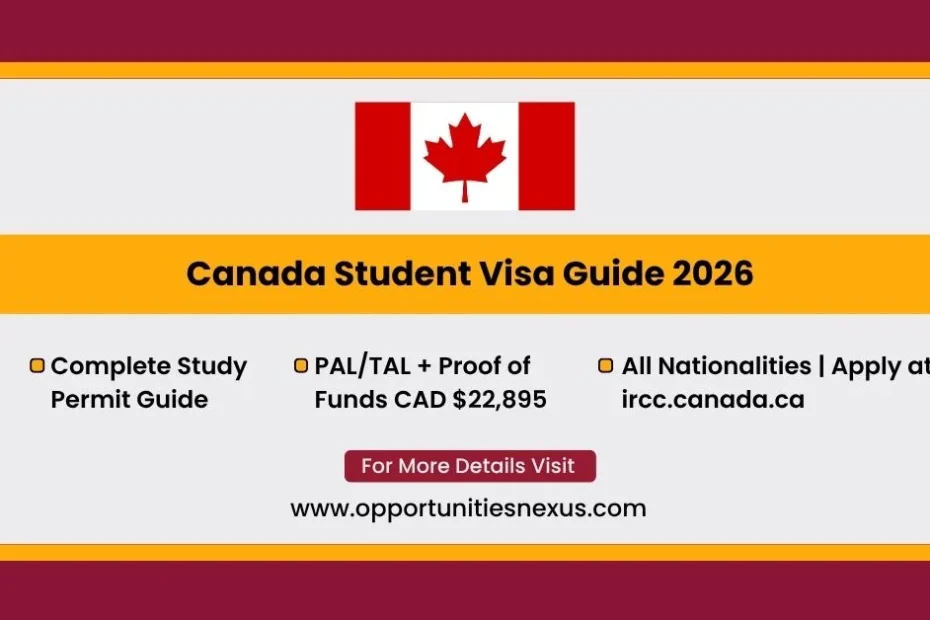
Canada is still one of the easiest places to study and work your way into a global career. If you are targeting the 2026/2027 intakes, you must adapt to important policy changes before you apply. This guide walks you through every step, from the new PAL/TAL rules to proof of funds, fees, and what to expect after graduation.
--Advertisement----Advertisement--
Read this completely before you submit. You will save weeks of back-and-forth and avoid refusals for simple mistakes. When you are ready, you can apply online at the official IRCC portal.
What is the Canada Study Permit?
The Canada study permit lets you study at a Designated Learning Institution (DLI) for more than six months. It is not a visa. If you are approved, IRCC issues a Port of Entry (POE) Letter and a temporary resident visa (TRV) or eTA if you need one. Your physical study permit is printed when you arrive in Canada.
With an active study permit, most international students can work off campus part time during study terms and full time during scheduled breaks. Many programs also support a Post-Graduation Work Permit (PGWP) after you finish.
Key 2026 Updates You Must Know
Proof of funds uplift: Minimum living expense requirement is CAD $22,895 for a single student outside Quebec, in addition to first year tuition and travel. Quebec uses a separate financial table.
PAL/TAL requirement continues: Most new applications need a Provincial or Territorial Attestation Letter (PAL/TAL) linked to the study permit cap.
New PAL exemptions for Master’s and PhD: In 2026, Master’s and PhD applicants are exempt from PAL/TAL. Keep proof of your graduate admission ready when you apply.
Study permit cap remains in effect: Provinces and territories control allocations via PAL/TAL for 2026/2027. Seats are limited, especially for undergraduate and college programs.
SDS discontinued: The Student Direct Stream (SDS) has been discontinued in 2026. All study permit files go through the standard online flow. Previous SDS-style completeness still helps you get faster decisions.
PGWP rules tightened for some private programs: Public college programs remain PGWP-eligible. Public-private partnership programs are not. Master’s graduates continue to qualify for a 3-year PGWP even if the program is under 2 years.
2026 Study Permit Cap and PAL/TAL Allocations
Canada is controlling the number of new study permits. Each province and territory receives a quota and issues attestation letters to applicants through schools. Without a PAL/TAL your application will be refused unless you are exempt.
Who needs a PAL/TAL: Most new undergraduate and college applicants applying from outside Canada.
Who is exempt in 2026: Master’s and PhD applicants, in-Canada extensions, minor children attending primary or secondary school, some exchange and visiting students. Always verify exemptions with your DLI.
How to get it: Your DLI requests a PAL/TAL from the province after issuing your offer. You cannot get a PAL/TAL yourself.
Action tip: Accept your offer quickly and meet deposit requirements so the school can queue your PAL/TAL while seats last for 2026/2027.
Eligibility Criteria in 2026
Valid Letter of Acceptance from a DLI
PAL/TAL if required by your program and province, or proof you are exempt
Proof of funds: tuition for the first year + CAD $22,895 living expenses for a single student outside Quebec + travel
Clean travel and immigration history, and intent to leave Canada after studies unless you legally transition
Biometrics and medical exam when required
Police certificate if requested
Strong study plan/SOP explaining your program choice, career path, and home ties
Required Documents Checklist
Passport valid for the full study period
Letter of Acceptance (LOA) issued by a DLI
PAL/TAL file or letter number if required, or evidence of exemption
Proof of funds:
Bank statements and bank letters
Education loan sanction letter from a recognized bank
GIC receipt if you choose to use a GIC
Scholarship or financial aid letters
Proof of tuition payment and receipts
Income documents for sponsors, with relationship evidence
Statement of Purpose or study plan
Academic transcripts, diplomas, and language test results if applicable
Digital photo meeting IRCC specs
Biometrics appointment confirmation
Medical exam info sheet (upfront or after IRCC request)
Police clearance if requested
Custodian declaration for minors
Proof of Funds in 2026
IRCC requires you to show you can pay for tuition, living expenses, and travel without relying on unauthorized work. For 2026 the minimum living expense for one student outside Quebec is CAD $22,895. This is separate from first year tuition and travel.
If you bring a spouse or children, you must show additional funds. Quebec has a different financial capacity table. Check the official IRCC and Quebec immigration pages for the current amounts for family members.
What IRCC Accepts as Proof
Recent bank statements and bank letters with average balances
Fixed deposits or term deposits that can be liquidated
Education loan from a recognized financial institution
Guaranteed Investment Certificate (GIC) from a Canadian bank
Scholarship, bursary, or assistantship letters stating the amount and duration
Official tuition receipts and accommodation payment receipts
Sponsor funds with legal source of income and relationship proof
Would You Like To Apply For This Opportunity?
Make your finances easy to understand. Show a clear path of funds, avoid unexplained large deposits, and match your study plan.
PAL/TAL Explained
A Provincial or Territorial Attestation Letter confirms a province has allocated a seat for your study permit under the national cap. Your school coordinates this with the province. You attach the letter or reference number to your IRCC application.
Still needed in 2026 for most undergraduate and college applicants applying from outside Canada
Exempt in 2026 for Master’s and PhD applicants, in-Canada extensions, and certain other categories
Timing: Many schools will not issue full admission packages until they secure your PAL/TAL. Pay deposits fast to avoid delays
Do not apply without a PAL/TAL if your category requires it. IRCC will refuse incomplete files.
Fees and Processing Times
Study permit fee: CAD $150
Biometrics: CAD $85
Medical exam: paid to panel physician, cost varies by country
VAC service charges and courier: vary by location
Processing time: It varies by country and season. Files with complete documents, medicals, biometrics, and where applicable PAL/TAL generally move faster. Check the IRCC processing time tool for the latest estimate.
Step-by-Step Application Process
Choose a DLI and program that fits your background and career plan. Confirm PGWP eligibility if you want to work after graduation.
Apply to the school and secure your Letter of Acceptance.
Request PAL/TAL via your school if your category requires it. Master’s and PhD applicants are exempt in 2026, but keep your graduate admission proof ready.
Organize finances: pay at least the first semester or year of tuition if you can, arrange GIC or loan, and gather proof of funds meeting the CAD $22,895 living expense threshold.
Create an IRCC account and start your online study permit application at ircc.canada.ca.
Upload documents: passport, LOA, PAL/TAL or exemption proof, SOP, proof of funds, photos, and any supporting letters.
Pay fees and submit. You will receive a Biometrics Instruction Letter if biometrics are required.
Give biometrics at a Visa Application Centre and complete your medical exam with a panel physician if requested.
Respond quickly to any IRCC requests for additional documents or a procedural fairness letter.
Decision: If approved you get a POE Letter and, if required, a TRV sticker. Carry all documents when you travel. Your study permit prints at the border.
Working While Studying in Canada
Off-campus work: Generally up to 20 hours per week during regular academic sessions, and full time during scheduled breaks. IRCC may pilot different hour caps for certain periods. Check current rules before you work.
On-campus work: Allowed if your DLI permits it.
Co-op/internship: Requires a separate co-op work permit and a co-op letter from your DLI.
Work is meant to support living costs, not replace your required proof of funds.
Post-Graduation Work Permit (PGWP)
Program 8 months to under 2 years: PGWP usually matches program length
Program 2 years or longer: Up to 3-year PGWP
Master’s graduates: Eligible for a 3-year PGWP even if the program is under 2 years
Ineligible programs: Most public-private partnership college programs
Distance learning limits: Too much online study can reduce PGWP length. Keep your DLI’s guidance and IRCC updates in mind
The PGWP is an open work permit. It is a powerful path to skilled Canadian experience for future immigration options.
Tips to Improve Your Approval Chances
Connect your program to your career: Show why Canada, why this DLI, and how the skills fit your job plan back home or globally.
Document your funds clearly: Use structured statements, loan sanctions, and receipts. Avoid unexplained cash spikes.
Show home ties: Family, employment history, property, or a clear return plan can help address intent to leave after studies.
Be consistent: Your SOP, finances, and past academics should tell one story without contradictions.
Submit a complete file: LOA, PAL/TAL if required, biometrics, medicals, and all forms properly signed and dated.
Frequently Asked Questions
Do I need a PAL/TAL for 2026?
--Advertisement----Advertisement--
Most new undergraduate and college applicants need a PAL/TAL because of the study permit cap. Master’s and PhD applicants are exempt in 2026, along with some other categories. Confirm with your DLI.
How much money do I need to show?
Show first year tuition, plus at least CAD $22,895 for living expenses for a single student outside Quebec, plus travel. If you have dependants or plan to study in Quebec, check the official tables for the latest amounts.
Is the Student Direct Stream (SDS) still available?
No. SDS is discontinued in 2026. All applications go through the standard online process. Submitting a complete, well-documented file remains the best way to get faster processing.
How long will my application take?
Processing time depends on your country, season, and whether your file is complete. Use IRCC’s processing time tool and apply early for 2026/2027 intakes.
Can I bring my spouse and children?
Yes, you can include your spouse or common-law partner and dependent children. Show additional funds and documents. Your spouse may be eligible for an open work permit depending on the current IRCC policy.
How to Apply
Confirm your DLI admission and PGWP eligibility
Secure your PAL/TAL if required, or verify exemption for Master’s/PhD
Visit the official website for the current deadline.
Final Call
Seats tied to PAL/TAL move fast, and proof of funds is stricter in 2026. Line up your LOA, finances, and documents now so you can submit a complete application without delays. Ready to start? Apply online at ircc.canada.ca and lock in your spot for the 2026/2027 intake.