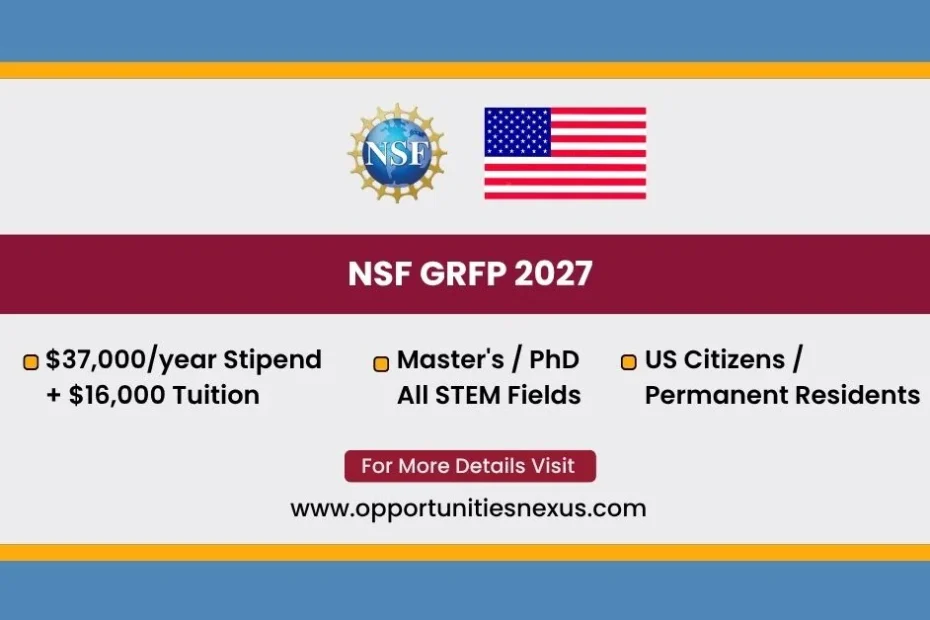
Ready to launch a research career with serious funding and national prestige? The NSF Graduate Research Fellowship Program (NSF GRFP) is one of the most powerful boosts you can get early in STEM. It offers a $37,000 annual stipend plus a $16,000 cost-of-education allowance to your university for 3 years of support used over a 5-year fellowship period.
--Advertisement----Advertisement--
If you are a high-potential researcher aiming for a research-based master’s or PhD in the United States, this is your moment. The 2026/2027 cycle is live, deadlines fall in October or November 2026 by discipline, and competition is intense. You will need a sharp research vision, clear broader impacts, and strong letters. This guide gives you exactly what to know and how to apply with confidence.
Why the NSF GRFP stands out in 2026/2027
Prestige that opens doors. Since 1952, GRFP Fellows have become leaders across academia, industry, and government. Winning early signals you are a top emerging researcher.
Flexible, portable funding. You choose when to activate each of your 3 funded years within a 5-year window, and you can typically switch institutions or advisors if your plans evolve.
High-pay support without work obligations. The stipend is for your development, not a teaching or research assistantship. You can focus on impactful research and training.
Stronger negotiating position. Many departments top up GRFP Fellows with extra perks like summer support, travel funds, or fee coverage.
What the fellowship covers
Funding Component
Amount
How It Works
Annual Stipend
$37,000
Paid via your university to support living and research-related costs during each funded year
Cost-of-Education Allowance
$16,000
Paid to your university to offset tuition and required fees. Universities set policies on how they apply this allowance
Duration
3 years of support
Use any 3 years within a 5-year fellowship period, typically starting in 2027
Important: the $16,000 allowance goes to the institution, not the student. Many departments cover any tuition above this amount or waive remaining fees for Fellows. Check your target program’s policy before you apply to understand the full funding picture.
Who can apply
Category
Eligibility
Citizenship
U.S. citizens, U.S. nationals, or U.S. permanent residents
Degree goal
Research-based master’s or PhD in an eligible STEM field at a U.S.-accredited institution
Career stage
Undergraduate seniors applying to grad school, post-baccalaureate researchers, or early-stage graduate students. Limits apply if you have significant prior graduate study
Program type
Academic research programs only. Professional degrees like MD, JD, MBA, DVM are not eligible
Enrollment timing
You must enroll at a U.S. institution for graduate study in the fellowship start year, typically 2027
Note for international readers: The NSF GRFP is not open to international students without U.S. citizenship, nationality, or permanent residency. If you are an international applicant, look at funded options like Fulbright Foreign Student, DAAD, Chevening, or institution-specific fellowships.
Eligible fields of study
NSF GRFP supports most NSF-funded STEM disciplines. Examples include:
Chemical, Mathematical, Physical Sciences and Astronomy
Computer and Information Sciences
Engineering disciplines
Geosciences and Environmental Sciences
Life Sciences, Biology, and related subfields
Materials Research
STEM Education research
Certain Social and Behavioral Sciences consistent with NSF scope
Fields centered on clinical practice, business, or professional training are not supported. Always verify your target field on the official list before applying.
Stipend vs tuition allowance – what it really means
Your stipend supports your living and research costs for each funded year. It is typically disbursed through your university payroll or financial aid system.
The cost-of-education allowance goes to your institution to offset tuition and mandatory fees. Some programs fully waive any remainder for GRFP Fellows. Others may cover most fees and ask you to use department or university scholarships for the rest.
Flex funding lets you spread your 3 funded years across your program for maximum impact. Many Fellows use unfunded years while on teaching or research assistantships, then switch back to GRFP support strategically.
How your application is reviewed
Reviewers score two core criteria. Design your package so both shine clearly.
Intellectual Merit: Your potential to advance knowledge. Evidence includes research experience, publications or posters, technical rigor, strong letters, and a compelling, feasible research plan.
Broader Impacts: Benefits to society and the research community. Examples include mentoring, outreach, open science, DEI efforts, policy relevance, entrepreneurship, and translational impacts.
Winning applications weave both criteria throughout every section, not just one paragraph. Show the what and the why, the methods and the impact.
Required documents
Personal, Relevant Background and Future Goals Statement that demonstrates your trajectory, motivations, and preparation for advanced research
Graduate Research Plan Statement describing a well-motivated question, methods, feasibility, and broader impacts
Three strong reference letters from faculty or research supervisors who can speak to your potential and contributions
Academic transcripts from all institutions attended. Unofficial transcripts are typically allowed for application review
Profiles and forms completed in Research.gov, including experiences and field of study selections
Would You Like To Apply For This Opportunity?
Follow the current NSF solicitation for page limits, formatting, and file types. Do not include extra materials outside what is permitted. GRE scores are not required.
Deadlines for the 2026/2027 cycle
Deadlines fall in October or November 2026, and they vary by discipline. The exact date depends on your selected field of study.
Check the official schedule for your field before you start
Plan to finish letters and statements at least 2 weeks early
If you miss the 2026 window, monitor the site for the 2027 cycle
Align your plan with NSF priorities. Emphasize fundamental research, innovation potential, open science, and societal benefits.
Make broader impacts real. Replace vague intentions with concrete, scalable actions you will execute at your target institution.
Show independence and feasibility. Present preliminary work, pilot data, or a clear path to de-risk your plan.
Coach your letter writers. Share bullet points tied to both review criteria so letters reinforce your narrative.
Polish with peer review. Get feedback from current Fellows, writing centers, and mentors. Iterate quickly.
Frequently asked questions
Who is eligible to apply?
U.S. citizens, U.S. nationals, and U.S. permanent residents pursuing a research-based master’s or PhD in an NSF-supported STEM field at a U.S. institution. Early-stage applicants are prioritized.
Can I apply if I have already started graduate school?
--Advertisement----Advertisement--
Yes, if you are early in your graduate program. There are limits on how much prior graduate study you can have. Check the current solicitation for the exact policy.
Are GRE scores required?
No. GRE scores are not required for the NSF GRFP application.
Can I hold GRFP with other fellowships or assistantships?
Policies vary. Some external fellowships or full assistantships may not be held concurrently with GRFP stipend years. You can typically defer GRFP support within the 5-year window. Coordinate with your graduate program on the final funding mix.
When are results announced?
Results are usually released in the first half of the year following the deadline. Exact timing varies by cycle.
Deadline and official links
Deadline window: October or November 2026 by discipline. Check the official schedule for your field.
If the schedule changes, the official website will post the current deadline. Always confirm dates before submitting.
Final thoughts
This is your chance to fund your ideas, not just your enrollment. Write boldly, cut jargon, and make your broader impacts real. If you are serious about research in 2026/2027, the NSF GRFP can change your trajectory. Start drafting today, line up your recommenders, and apply now.